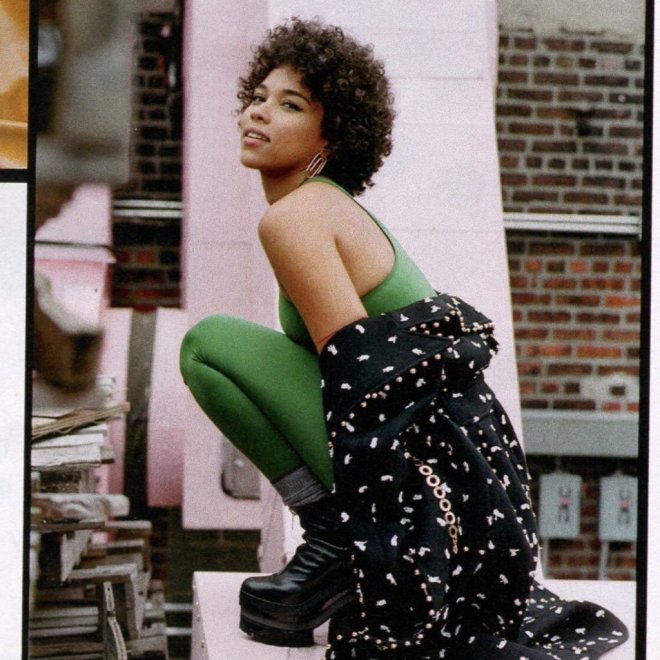
Alexandra Shipp is back on her b.s.
The last time the internet saw her, the Love, Simon actress was fighting folks on twitter over her role as Storm in the X-Men franchise.
In light of news that Marvel bought Fox, many took to twitter to share their hopes about getting a Storm movie. Shipp was initially excited about this, tweeting that she was all up for taking on the role. After many responded, however, that they’d rather have her re-cast for a dark-skinned actress in order to get some dark-skin representation, she tweeted out that they were being “racist” and refused to get into the subject any further.

Now she’s back again speaking on colorism without any sign of comprehension, this time for Heroine Magazine.
When the controversy came up in her interview, Shipp expressed outrage at people who were trying to raise the issue of colorism in her casting as Storm. She asked them to reflect on why her personal experience as a biracial woman offended them so much, pointing out how she didn’t use blackface while playing the role, which to her, made it perfectly alright.
“You can’t tell me that I can’t play a woman of color because I don’t match the Crayola marker from 1975 when they drew the comic, that makes no sense.”
To Shipp, the only way to correct the issue of colorism in Hollywood is by letting light-skinned actresses take on the roles of … dark-skinned characters.
“The only way we can create social change is not by denying ourselves roles but taking those roles and making them our own.”

Colorism comes from racism. Its origins date back to the Atlantic Slave Trade where light-skinned children of enslaved Black women raped by their white masters were given better treatment than dark-skinned ones. Often times light-skinned slaves were brought into the house to do less physically tasking domestic work while dark-skinned slaves were left outside in the fields.
In a white supremacist society where whiteness is held as the standard, those who have a closer proximation to whiteness appearance wise–having more European features like loser hair, lighter eyes, and above all lighter skin–are treated better under it. This creates a power dynamic that puts people who are light-skinned above people who are dark-skinned in the eye of society giving light-skinned people privilege. We see this privilege play out all the time whether it’s light-skinned people being seen as more intelligent, being seen as less dangerous, being less likely to be racially profiled, or being less likely to be punished in schools.
For Black women, colorism is even more of a problem. As women, whether we are valued or not largely depends on our perceived beauty. Black women are already heavily scrutinized against Eurocentric beauty standards because of our Blackness. Add in colorism, and dark-skinned Black women are pushed even further outside of society’s beauty standard undermining our value.
Hollywood isn’t much help. The industry perpetuates these ideas about dark-skinned Black women by exclusively hiring light-skinned women to play as Black women in general. This sends out a message that there’s only one good way for Blackness to exist and that’s when it best adheres to whiteness thereby reinforcing the message of white supremacy and making it more difficult for dark-skinned women to be valued by society and by themselves.
Alexandra Shipp doesn’t get that her roles exit within the context of Hollywood’s colorism meaning that her roles will always carry racial and colorist implications no matter what. Despite what she thinks, her playing dark-skinned characters won’t create better representation for Black women. It only contributes to the erasure of dark-skinned women further perpetuating the negative ways society views them as well as racist and colorist ideals. Doubling down in a oppressive structure doesn’t do anything to dismantle it. Undermining that structure by actively avoiding roles for dark-skinned women and making room for them does.
Shipp says it’s not realistic.
“If all of us banned together in a perfect world and say no, this is meant for a darker skinned actress, the studio would say you’ve lost your damn mind and hire a younger, light skinned actress.”
But her argument doesn’t even make sense. If all the light-skinned actresses in Hollywood teamed up, there wouldn’t be one for the industry to go to forcing them to pick a dark-skinned actress instead. We’ve already seen this work before with whitewashing when British actor Ed Skrein left Lionsgate’s Hellboyreboot after realizing he’d be playing a Japanese-American character.
Shipp says she’s up for having this conversation on colorism, but it’s clear that she still doesn’t get what it’s about. It’s not about her Blackness or her biraciality, but about the benefits she gets from being a light-skinned Black woman in the Hollywood industry and how that negatively impacts others.
If Shipp really wants to create social change within Hollywood like she says in her interview, she needs to start by checking her own light-skinned privilege and recognize how it makes her complicit in the industry’s culture.

 Glamdom